


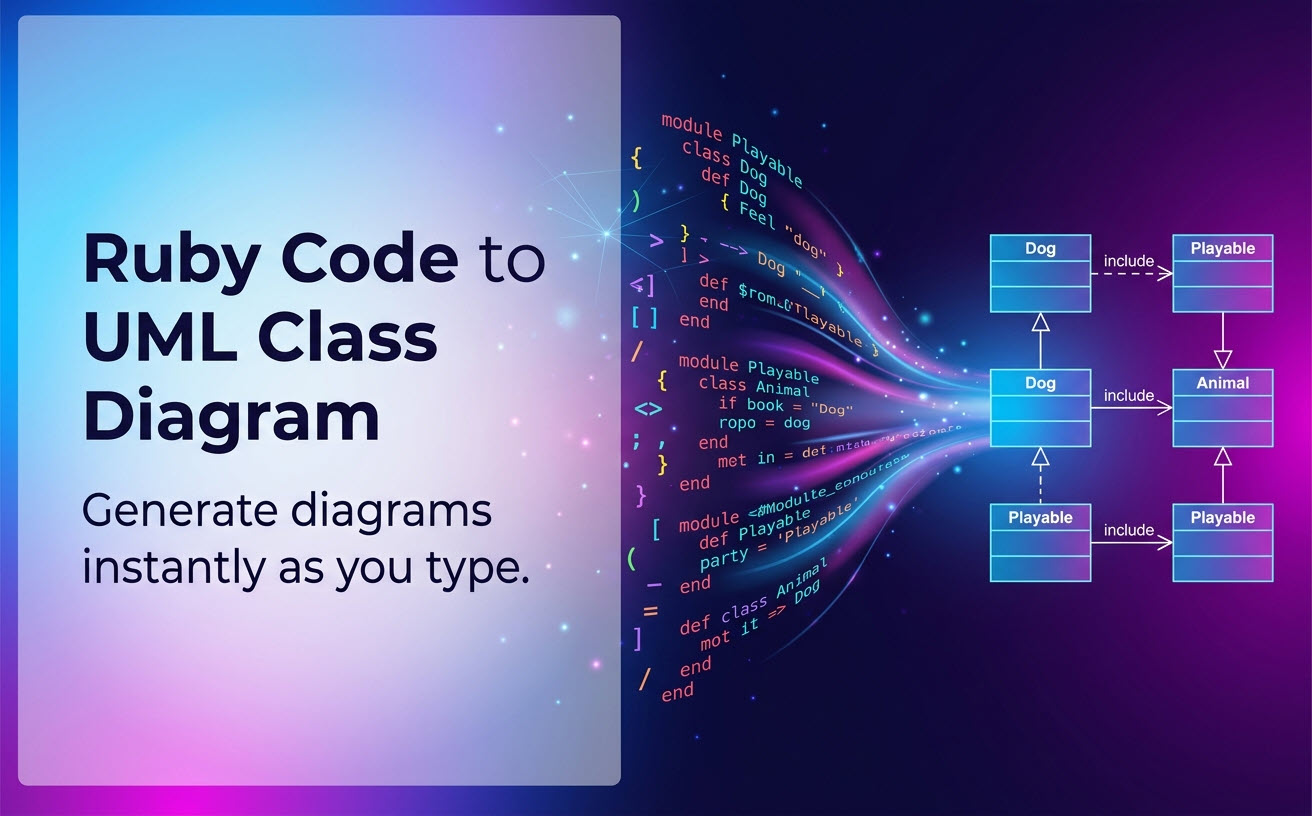
As object-oriented software architectures scale, maintaining clean class hierarchies and understanding complex relationships becomes a key engineering challenge. Ruby’s dynamic nature, combined with mixins, inheritance, and modern static typing systems like Sorbet, makes high-level code visualization essential for developers, software architects, and technical writers.
We are thrilled to announce a major update to Visual Paradigm VPasCode: native code-to-diagram visualization support for Ruby alongside 13 other top programming languages (including Java, TypeScript, Go, Rust, C#, Python, C, C++, PHP, Scala, Zig, Kotlin, Swift, and Elixir). You can now convert raw Ruby source code directly into interactive, clean UML class diagrams in real time without writing manual diagram scripting DSLs.
Whether you are looking for an intuitive online Ruby diagram tool, a streamlined free Ruby editor, or a powerful diagram-as-code tool, VPasCode simplifies how you document and understand object-oriented Ruby applications.
What is VPasCode?
VPasCode (Visual Paradigm’s diagram-as-code platform) is a unified web-based environment designed to convert code, data structures, and markup into professional visual representations. Instead of switching between multiple separate converters, VPasCode acts as a single web app for popular text-to-diagram languages like PlantUML, Mermaid, Graphviz, Markmap, and ECharts.
Beyond traditional diagram scripts, VPasCode features automatic code detection and deep source code visualization across structured data formats (JSON, YAML, XML, CSV, TOML), SQL schemas, and mainstream object-oriented programming languages.
Key highlights of the VPasCode ecosystem include:
- Automatic Code Detection: Simply paste your snippet or load a file. VPasCode inspects the syntax, identifies the language, and renders the corresponding visual structure instantly.
- Integrated AI Assistance: Fix syntax errors on the fly using automated AI Code Error Fixing and view side-by-side diffs to learn from the corrections. You can also leverage AI Diagram Translation to translate visual nodes across international languages.
- Documentation Workflow Integration: Export diagrams straight into Visual Paradigm OpenDocs through our seamless OpenDocs integration for technical specifications and project wikis.
How Ruby Visualization Works in VPasCode
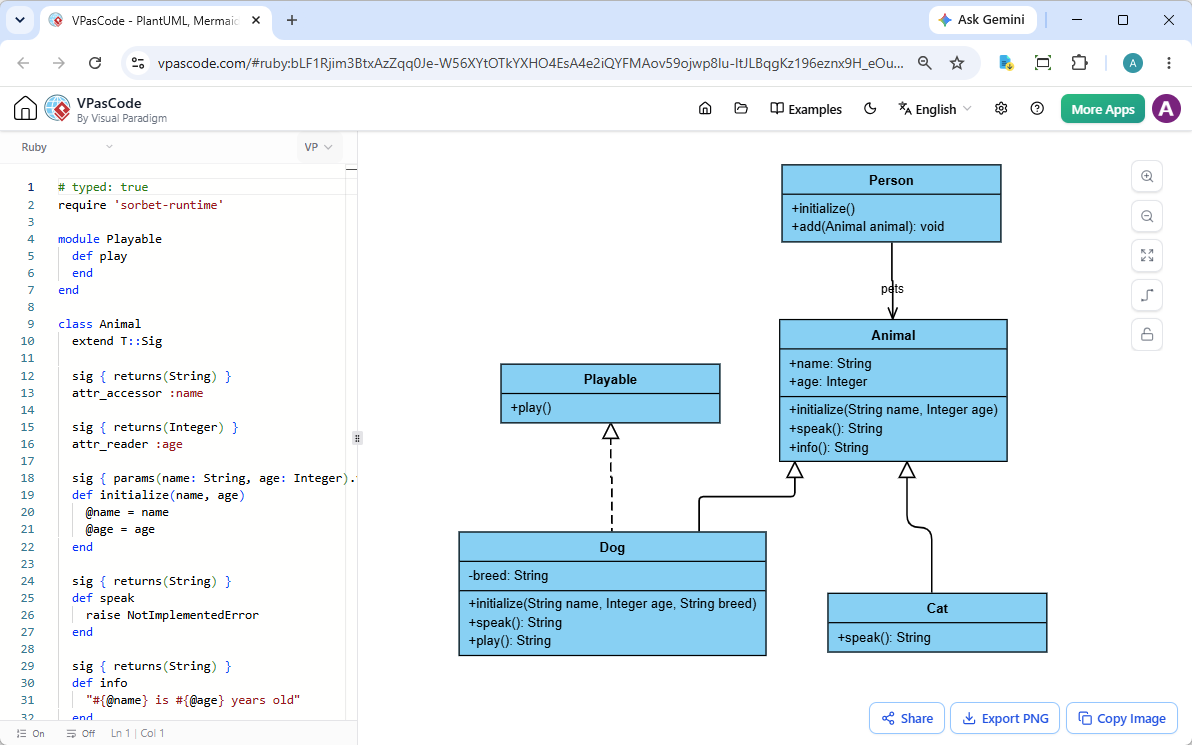
Using VPasCode as your primary online Ruby diagram tool is straightforward and frictionless:
- Paste or Drag and Drop: Open the VPasCode interactive editor. You can directly type or paste Ruby code into the editor pan on the left, or drop a
.rbsource file straight into the interface. - Instant UML Generation: The right pane immediately parses the classes, inherited parents, module mixins (
include/extend), methods, and properties, rendering a standard UML class diagram dynamically. - Share & Export: Once satisfied, copy the visual image directly to your clipboard, export it as high-resolution SVG vector art or PNG images, or share a live link with team members without requiring any login or setup.
Live Example: Visualizing Object-Oriented Ruby with Sorbet Types
To demonstrate the capability of our diagram-as-code tool, let’s look at a complete Ruby snippet utilizing Sorbet static typing signatures (sig), inheritance, module inclusion, and collection attributes.
# typed: true
require 'sorbet-runtime'

module Playable
  def play
  end
end

class Animal
  extend T::Sig

  sig { returns(String) }
  attr_accessor :name

  sig { returns(Integer) }
  attr_reader :age

  sig { params(name: String, age: Integer).void }
  def initialize(name, age)
    @name = name
    @age = age
  end

  sig { returns(String) }
  def speak
    raise NotImplementedError
  end

  sig { returns(String) }
  def info
    "#{@name} is #{@age} years old"
  end
end

class Dog < Animal
  include Playable
  extend T::Sig

  sig { params(name: String, age: Integer, breed: String).void }
  def initialize(name, age, breed)
    super(name, age)
    @breed = breed
  end

  sig { returns(String) }
  def speak
    "Woof!"
  end

  sig { returns(String) }
  def play
    "#{@name} is playing fetch"
  end
end

class Cat < Animal
  extend T::Sig

  sig { returns(String) }
  def speak
    "Meow!"
  end
end

class Person
  extend T::Sig

  sig { returns(T::Array[Animal]) }
  attr_reader :pets

  sig { void }
  def initialize
    @pets = []
  end

  sig { params(animal: Animal).void }
  def add(animal)
    @pets << animal if animal.is_a?(Animal)
  end
end
What VPasCode Highlights in this Diagram
- Class Inheritance: Displays clear generalization relationships from
DogandCatextending the baseAnimalclass. - Module Mixins: Visually identifies the
Playablemodule interface included inside theDogclass. - Attributes & Accessors: Maps
attr_accessorandattr_readerdefinitions directly into UML field attributes with corresponding visibility levels. - Aggregations & Associations: Translates relationships such as
Personmanaging collections ofAnimalobjects (T::Array[Animal]).
>> Click here to open and edit this live Ruby UML example in VPasCode
Exporting, Sharing, and Accessing Features
VPasCode makes sharing architectural visualizations fast and flexible across engineering teams:
- Instant Share Links: Generate permalinks that embed your exact source code and diagram state directly into the URL—no sign-up or user account necessary for viewers.
- Production-Ready Image Exports: Download crisp SVG vector graphics for high-resolution documentation or copy PNG images straight to your clipboard for rapid inclusion in pull requests, Slack threads, or slide decks.
- Free vs. Advanced Capabilities: Core diagram creation, live real-time editing, drag-and-drop file imports, and vector/raster image exports are 100% free to use. Advanced AI capabilities (such as AI Code Error Fixing and AI Diagram Translation) are available for users subscribed to Visual Paradigm Online Combo Edition (or higher) and Visual Paradigm Desktop Professional Edition (or higher) with active maintenance.
Try the Ultimate Free Ruby Editor & Diagram Tool Today
Stop spending manual hours hand-crafting architecture diagrams in generic drawing applications. Experience the speed of automated visual code analysis with VPasCode’s all-in-one diagram-as-code tool.
Ready to map out your Ruby applications?
Launch the Free Online VPasCode Editor Now
Unified Platform entrance of VPasCode: Under the “Developer” category of the app hub.