


As a leading visual modeling software provider, Visual Paradigm is proud to be the first software vendor to deliver full support for ArchiMate 4 (Pre-Release) – the exciting next evolution of the ArchiMate® Specification from The Open Group.
Visual Paradigm 18.0 now includes complete, standards-compliant ArchiMate 4 tool, so you can start modeling with the latest specification today – without waiting for others to catch up. This early support ensures your enterprise architecture work stays ahead of the curve, fully aligned with the upcoming official release.
Key highlights of Visual Paradigm’s ArchiMate 4 implementation:
- A brand-new ArchiMate 4 diagram editor and palette that fully incorporates the specification changes – including the introduction of symbols for the Common Domain and the clean removal of retired elements.
- Full backward compatibility: ArchiMate 3.2 diagrams remain fully editable and usable as before, with no forced migration required.
- Native multiplicity support on connectors, enabling precise cardinality constraints (e.g., 1..*, 0..1) exactly as defined in ArchiMate 4.
- Document generation, Project Publisher, Export/Import XML, Team Collaboration and other related features are all enhanced to support ArchiMate 4.
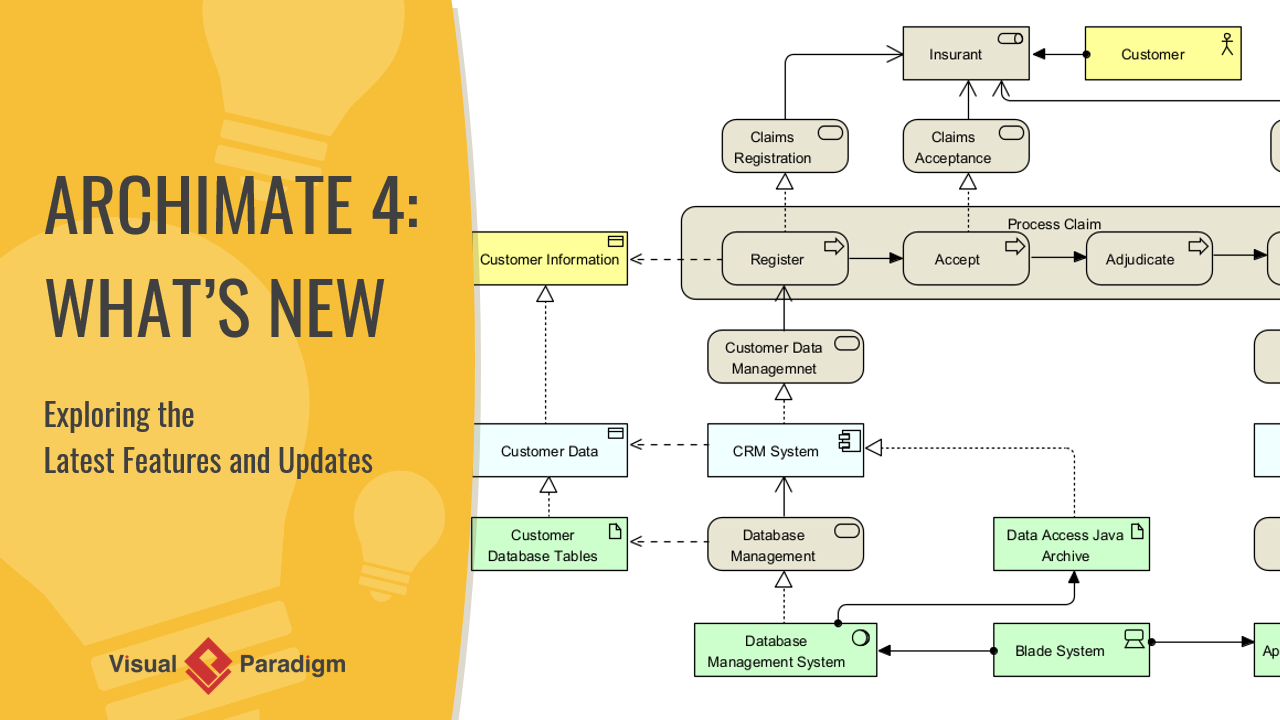
The Core Philosophy: The updates in ArchiMate 4 are driven by the principle of “Simplicity over Comprehensiveness,” ensuring the language remains a streamlined tool for communicating complex architectures without unnecessary overhead.
Now, let’s take a look at the changes in ArchiMate 4 – all supported by Visual Paradigm’s ArchiMate 4 software tool.
1. A Paradigm Shift: The ArchiMate Hexagonion
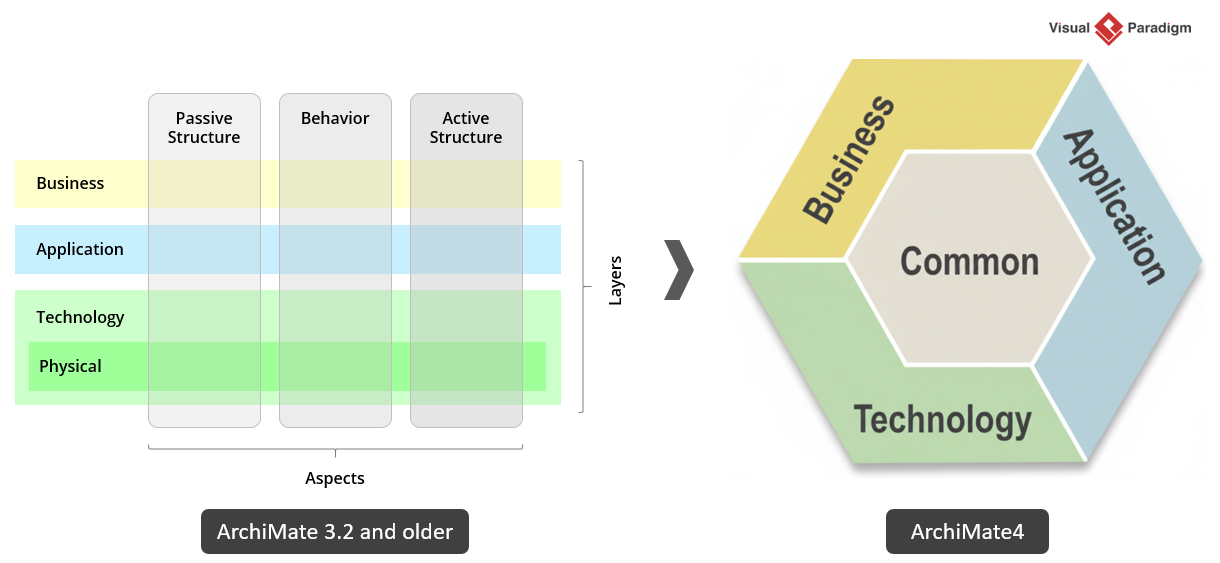
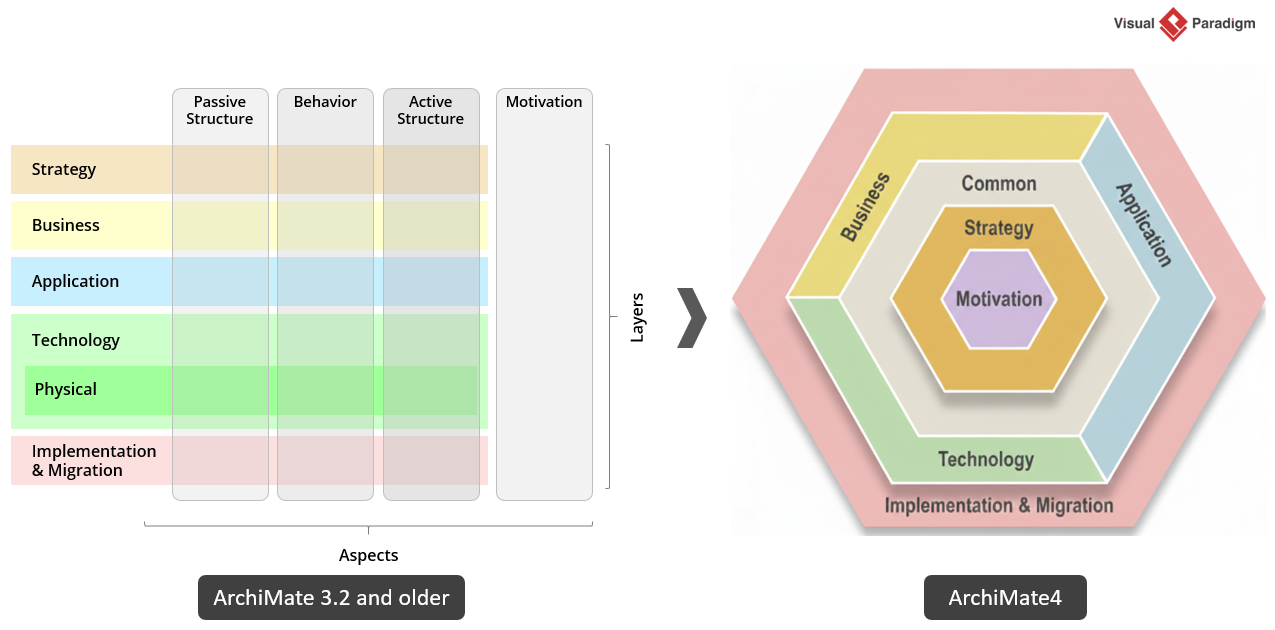
The most visible change in ArchiMate 4 is how the language itself is depicted. The traditional matrix combining aspects and layers has been replaced by the “ArchiMate Hexagonion”.
- From Layers to Domains: The term “layer” has been replaced by the more generic and flexible term “domain”.
- Motivation at the Center: The new structure intentionally places the Motivation Domain at the center, radiating outward to strategy, core architectural designs, and implementation.
The Advancement: This shift emphasizes that architecture is driven by goals and outcomes rather than just technical stacks. It provides a more integrated view of the enterprise.
ArchiMate 4 Core Language
The ArchiMate core language defines a set of domains with specific active, behavior, and passive structure elements. Four domains are defined within the ArchiMate core language as follows:
- The Common Domain, which contains generic elements (in particular behavior elements) that can be used in combination with elements from different domains
- The Business Domain depicts the organization, how it relates to its internal and external customers, and what it consumes and produces
- The Application Domain depicts the applications, how they work together to support the business, and which data they process
- The Technology Domain comprises both information technology and operational (physical) technology
Next to these core domains, the language also comprises:
- The Motivation Domain, containing elements to model stakeholders, goals, and other related contexts and motivations that drive the architecture
- The Strategy Domain, used to model strategic direction and choices, based on the motivation of the enterprise
- The Implementation and Migration Domain, with elements for modeling the evolution and implementation of architectures
2. Streamlined Behavior and Structure
To reduce language complexity, several elements that were previously layer-specific have been merged into generic, reusable concepts.
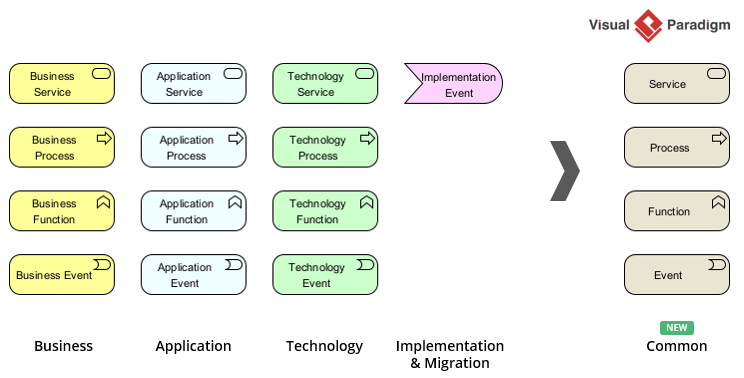
Unified Behavior Elements
Instead of having separate business, application, and technology versions of behaviors, ArchiMate 4 introduces a single set of generic behavior elements: Service, Process, Function, and Event. The specific “Implementation Event” has been retired in favor of the now-universal Event element.
Unified Collaboration Elements
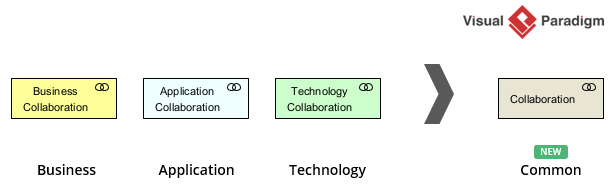
Business, application, and technology collaborations have been merged into a single Collaboration element.
Replacement of Business Role
The “Business Role” has been replaced by a generic Role element. This new Role is highly flexible and can be assigned to any internal active structure element across the entire language.
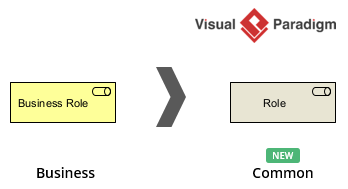
The Benefit: This consolidation reduces the number of unique elements a modeler needs to learn, fulfilling the “needs of the many” by simplifying the core 80% of modeling tasks.
3. Enhanced Relationship Precision
Relationships have received technical upgrades that allow for more sophisticated data constraints and cleaner diagrams.
Multiplicity Support
Relationships can now have multiplicity. This allows modelers to specify exactly how many instances are allowed at each end of a relationship (e.g., 1..*, 0..1).
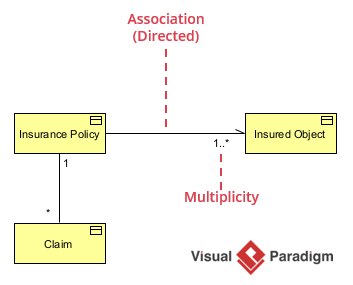
The Advancement: While ArchiMate focuses on types rather than instances, multiplicity allows for the formal expression of business constraints within the architecture.
Simplifying Structure: Removal of Composition
The Composition relationship has been removed from the core set of relationships. Elements that require grouping can now rely on the Aggregation relationship or the specialized Grouping element.
Path and Connectivity Updates
- Path: This concept has moved to the Common Domain, reflecting its utility across business, application, and technology contexts.
- Realization over Aggregation: The relationship from active structure elements to a Path is now modeled as Realization rather than Aggregation.
4. Retiring Redundancy: Removed Elements
To maintain a lean metamodel, several specialized elements have been removed. These are now modeled as specializations of more generic counterparts.
- Interactions: Business, Application, and Technology Interaction elements are removed.
- Architecture Constructs: Constraint, Contract, Gap, and Representation are removed.
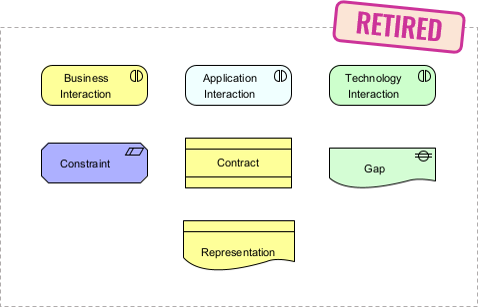
Migration Tip: Most removed elements can be easily transformed. For example, a Constraint can be replaced by a specialization of Requirement, and a Contract can be modeled as a specialization of Business Object.
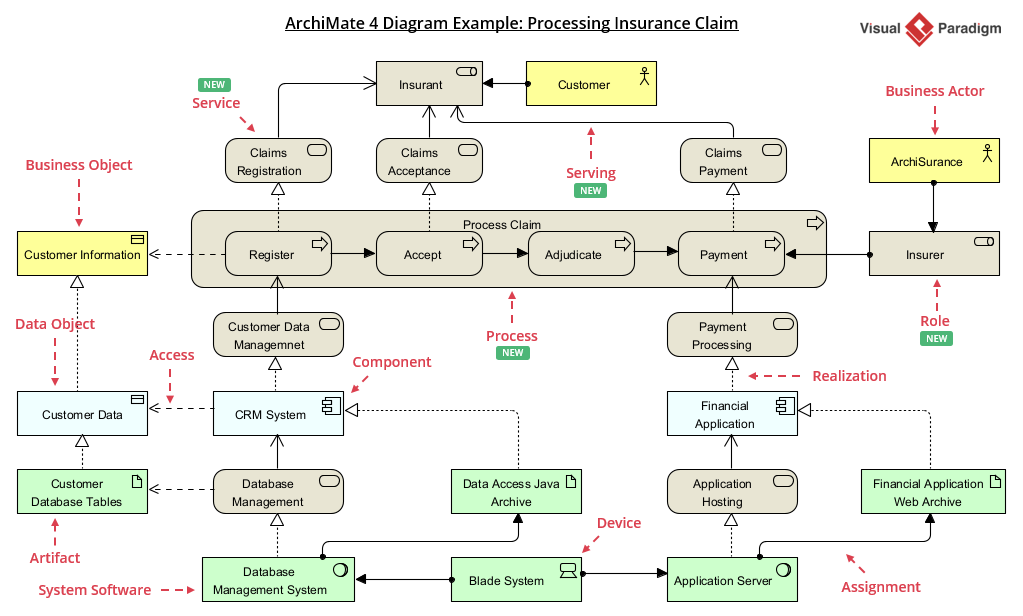
ArchiMate 4 Diagram Example
Below is an ArchiMate 4 diagram example shows how the cross-domain relationships integrate the different domains, and how this can be depicted in one view, using the elements from the Common (New), Business, Application and Technology domains.
Conclusion: Why ArchiMate 4 Matters – and Why Visual Paradigm Leads the Way
ArchiMate 4 represents a “people over tools” approach. By merging layers into domains and consolidating redundant elements, it makes Enterprise Architecture more accessible to stakeholders while providing the technical “multiplicity” features that advanced architects need.
Visual Paradigm 18.0 gives you immediate, comprehensive support for ArchiMate 4 (Pre-Release) — including the new palette, multiplicity, backward compatibility with 3.2, and more — making us the first mover in the market.
Ready to model with the future of ArchiMate today?
Upgrade to Visual Paradigm 18.0 and experience full ArchiMate 4 compliance right now.